Skip to content

How to Create a Link Building Strategy (A Practical, Risk-Managed Framework)
What a Link Building Strategy Actually Is (And Why Tactics Alone Fail)
Most articles that claim to explain “link building strategy” are actually lists of tactics. Guest posting. Broken link building. Resource pages. Digital PR.
Those are methods, not strategy.
A link building strategy is the system that determines:
-
Why you are building links
-
Which pages deserve links
-
What types of links will create the intended outcome
-
How risk is managed over time
-
How success is measured beyond raw link counts
Without that framework, even high-quality links can underperform — or worse, introduce instability.
Strategy comes before execution. Tactics are simply tools deployed inside that structure.
Step 1: Define the Real Objective of Your Link Building Campaign
Before analysing competitors or prospecting a single website, you need to define what a successful link building campaign actually looks like. This sounds obvious, but it’s where many campaigns quietly fail.
Ranking, Traffic, and Authority Are Not the Same Goal
Not all links serve the same purpose.
-
Some links exist primarily to move rankings
-
Some exist to send qualified referral traffic
-
Others reinforce brand authority and trust
A common mistake is assuming every backlink should do all three. In practice, very few links do.
For example:
-
A highly relevant editorial link may significantly influence rankings without sending noticeable traffic
-
A prominent media mention may send traffic and brand signals but have limited ranking impact on a specific page
A strategy acknowledges these differences and plans for them deliberately.
Map Links to Page Intent
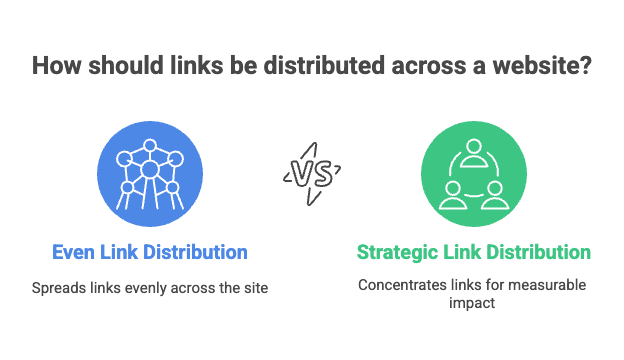
Every link should support a specific page objective, such as:
-
Strengthening a commercial service page
-
Elevating a pillar article
-
Supporting a cluster of related content
Trying to “spread links evenly” across a site usually results in diluted impact. Strategic campaigns concentrate links where they create measurable movement, then expand outward once momentum is established.
At this stage, your strategy should clearly define:
-
Priority pages
-
Secondary support pages
-
Pages that should not receive links yet
Step 2: Establish Baselines Before You Build a Single Link
Link building without baselines is guesswork. Radomly throwing links at your site just won’t cut it.
Before executing, you need to understand where you’re starting from, both internally and externally.
SERP & Competitor Link Landscape Analysis
Rather than counting backlinks, focus on patterns:
-
What types of pages are ranking?
-
What kinds of sites are linking to them?
-
Are links primarily editorial, commercial, or user-generated?
-
Is authority concentrated or broadly distributed?
This reveals how competitive the SERP actually is, not just how many links competitors have.
Two pages with the same backlink count may require completely different strategies depending on relevance, content depth, and link quality distribution.
Internal Readiness Check (Often Overlooked)
Links strengthen what is already working — they do not repair weak pages.
Before investing time or budget into link building, it’s important to check whether the page itself is ready to benefit from added authority. This includes reviewing:
-
Content depth and clarity
-
Internal linking support from related pages
-
Alignment with the search intent behind the query
-
Page structure, usability, and readability
If a page would struggle to compete even without considering backlinks, adding links is unlikely to create lasting improvement. Strong strategies focus on improving pages first, then applying links once they are capable of turning authority into rankings.
This step is often skipped — and it is one of the clearest differences between deliberate, results-driven campaigns and volume-led link building.
Step 3: Evaluate Link Opportunities Using a Strategic Scoring Model
Most guides evaluate link prospects using surface-level metrics. That’s not enough.
Strategic link evaluation looks at how a link fits into the wider ecosystem, not just where it comes from.
Why Metrics Alone Are Incomplete
Metrics such as Domain Rating, traffic estimates, or spam scores are proxies, not signals used by search engines.
They can help filter extremes, but they do not explain:
-
How the linking page is interpreted
-
Whether the link reinforces topical relevance
-
How the site behaves editorially
Treat metrics as a starting filter, not a decision-maker.
Strategic Link Qualification Factors
Higher-impact strategies evaluate opportunities using qualitative signals, including:
-
Topical alignment between linking page and target page
-
Contextual placement within meaningful content
-
Editorial selectiveness of the publisher
-
Outbound link behaviour (who else they link to, and how often)
-
Commercial saturation of the site
These factors determine whether a link acts as a genuine endorsement or just another outbound reference.
This is also where many low-cost campaigns break down — they optimise for scale, not strategic fit.
Where This Leaves the Strategy So Far
At this point, a real link building strategy has:
-
A clearly defined objective
-
Priority pages mapped to outcomes
-
A realistic understanding of competition
-
A quality framework for evaluating opportunities
Only now does it make sense to choose acquisition methods, plan velocity, and scale execution.
Step 4: Choose the Right Link Acquisition Methods
Once objectives are clear and link opportunities can be evaluated properly, the next decision is how links should be acquired.
A strategy does not attempt to use every possible method. Instead, it selects acquisition approaches that align with:
-
Page intent
-
Resource availability
-
Risk tolerance
-
Editorial standards in the niche
Different pages require different types of links. A homepage, a pillar guide, and a product or service page should not all be promoted in the same way.
Editorial Outreach, Content-Led Links, and Partnerships
Most acquisition methods fall into three broad categories.
Editorial outreach focuses on securing links that are placed at the discretion of a publisher. These links are typically contextual, embedded within content, and surrounded by relevant topical signals. They are slower to earn, but tend to carry strong trust signals.
Content-led links are earned by creating assets that naturally attract references, such as research, tools, or definitive guides. These links often accumulate over time and are especially effective for strengthening informational content.
Partnership-driven links arise from relationships with organisations, vendors, or collaborators. These links can be highly relevant, but must be handled carefully to avoid footprints or overly commercial patterns.
A strong strategy chooses the minimum effective mix of methods rather than spreading effort across every option.
Match Acquisition Methods to Page Intent
Not all links are equally suitable for all pages.
-
Informational content often benefits from editorial and content-led links
-
Category or service pages typically require fewer but more carefully placed contextual endorsements
-
Supporting content can absorb higher link volume without introducing risk
Attempting to promote commercial pages using high-volume tactics designed for blog content often results in poor performance or instability.
Step 5: Anchor Text Strategy Without Creating Risk
Anchor text remains one of the most sensitive aspects of link building, yet it is still frequently misunderstood.
The goal is not to manipulate relevance signals directly, but to reinforce clarity about what a page represents.
Why Fixed Anchor Ratios Fail
Many strategies rely on predefined anchor text percentages. These models assume that search engines evaluate links in isolation. In reality, anchor text is interpreted in context.
The same anchor can have different implications depending on:
-
The linking page’s topic
-
Surrounding text
-
The site’s overall link profile
-
The intent of the target page
Rigid ratios ignore these variables and often lead to over-optimisation.
Intent-Aligned Anchor Selection
Effective anchor strategies consider intent first.
-
Branded anchors reinforce trust and legitimacy
-
Navigational anchors clarify destination purpose
-
Contextual anchors support topical alignment without forcing keywords
When anchors reflect how real publishers naturally reference content, they blend into the link profile instead of standing out as engineered signals.
Anchor text should evolve gradually as authority increases, not be forced early in a campaign.
Step 6: Plan Link Velocity and Campaign Cadence

How many links should I build per month?” is one of the most common questions in link building — and there isn’t one single answer.
Link velocity should be based on natural trafic growth as well as competitor link data.
Why Fixed Monthly Targets Are Misleading
Setting arbitrary link quotas often results in:
-
Lower quality placements
-
Repetitive patterns
-
Increased risk exposure
Search engines do not reward consistency in numbers; they reward consistency in signals. Natural link growth is irregular, influenced by content publication, brand exposure, and market activity.
Align Link Growth With Real Activity
Strategic campaigns align link acquisition with:
-
Content publishing schedules
-
Marketing campaigns
-
Public announcements or partnerships
-
Competitive movement within the SERP
Periods of higher activity followed by quieter phases are not inherently risky when they align with real-world behaviour, which is why it’s important to understand what link building is.
Competitive analysis can provide context, but should not dictate pace. The objective is sustainability, not imitation.
Strategy Progress Checkpoint
By this stage, a complete strategy includes:
-
Clear objectives tied to specific pages
-
Qualified link opportunities based on relevance and context
-
Selected acquisition methods aligned with page intent
-
A risk-aware approach to anchors and velocity
What remains is to ensure the strategy can withstand algorithm changes, be measured meaningfully, and scale without degradation.
Step 7: Manage Risk and Maintain Long-Term Stability
A sustainable link building strategy does not aim to avoid all risk. It aims to control exposure so that growth is durable rather than fragile.
Search engines rarely penalise single actions in isolation. Issues arise when patterns accumulate over time.
Common Risk Signals in Link Building
Most instability stems from repetition rather than intent. Risk increases when link acquisition shows consistent patterns such as:
-
Repeated anchor phrasing across unrelated sites
-
Similar content formats used for every placement
-
Links consistently appearing on pages with heavy outbound linking
-
Overrepresentation of commercial anchors pointing to money pages
-
Rapid increases in links without corresponding brand or content activity
None of these elements are necessarily problematic on their own. Combined, they create footprints that are easy to identify algorithmically.
Designing Campaigns That Withstand Algorithm Changes
Risk-managed strategies prioritise:
-
Editorial discretion over guaranteed placements
-
Variation in link sources, formats, and context
-
A natural balance between informational and commercial reinforcement
The strongest link profiles are those that still make sense when viewed holistically. If the logic of a campaign would appear reasonable to a human reviewer, it is far more likely to withstand algorithm updates.
Step 8: Measure What Actually Works (Beyond Link Counts)
Link building is often measured poorly. Counting links is easy, but it rarely explains performance.
Effective strategies focus on impact, not volume.
KPIs That Reflect Real Progress
Meaningful indicators include:
-
Ranking movement at the page level
-
Changes in keyword distribution, not just top positions
-
Traffic quality and engagement on linked pages
-
Assisted conversions where links support broader journeys
Not every link produces immediate movement. Some reinforce authority gradually, contributing to future performance rather than instant results.
Correlation, Causation, and Time Lag
Attribution in link building is imperfect by nature. Rankings are influenced by multiple variables, and the effect of a link may not be visible for weeks or months.
Strong strategies account for this by:
-
Tracking trends rather than isolated changes
-
Comparing performance across similar pages
-
Avoiding reactionary decisions based on short-term fluctuations
Patience is not passive — it is a deliberate part of strategic measurement.
Step 9: Scale the Strategy Without Diluting Quality
Scaling link building is where many campaigns lose effectiveness. What works at low volume often breaks when expanded without structure.
From Manual Execution to Systemised Process
Sustainable scaling depends on systems, not shortcuts. This includes:
-
Documented qualification criteria
-
Clear editorial standards
-
Consistent review processes
-
Ongoing refinement based on results
Scaling should increase efficiency, not reduce selectiveness.
In-House vs Outsourced Execution
As campaigns grow, resource decisions become unavoidable.
In-house execution offers control but requires time, training, and ongoing oversight. Outsourced execution can accelerate growth, but only when transparency and quality standards are clearly defined.
The most effective strategies treat outsourcing as an extension of internal processes rather than a replacement for them.
Example: A Realistic Link Building Strategy Blueprint
Consider a site aiming to improve visibility for a core service page while building long-term authority in its niche.
The strategy might involve:
-
Strengthening a supporting pillar article first
-
Earning editorial links to that content through targeted outreach
-
Reinforcing internal linking to funnel authority toward the service page
-
Gradually introducing contextual endorsements for commercial pages
-
Monitoring ranking stability before increasing volume
This phased approach prioritises momentum and resilience over speed.
When a Managed Link Building Service Makes Sense
Not every business has the team or expertise to build links internally.
Managed link building becomes a practical option when:
-
Internal resources are constrained
-
Consistency is difficult to maintain
-
Editorial access is limited
-
Risk management requires specialist experience
In these cases, transparency, selectiveness, and alignment with broader SEO goals matter far more than promised volume.
Final Thoughts
A link building strategy is not a checklist. It is a framework for making decisions over time.
When objectives are clear, opportunities are evaluated properly, and execution aligns with real-world behaviour, links become a compounding asset rather than a recurring concern.
The difference between campaigns that plateau and those that scale is a well planed out strategy. Get this right and you will be competitive regardless of the niche.